Sunday, June 9, 2013

 From Belgium (aka SATS)
The New Great Game in the Old Russian Empire - (Part 2 of 2)

The Dilemma of the Caucasus

In the spring of 2010, Secretary of Defence Gates paid a visit to countries within the Caucasus region. This was followed a couple of months later by a visit by Secretary of State Hillary Clinton who covered much of the same ground. At the time it was reported that not much was expected to come out of these talks and in fact, not much was achieved. The question then comes of why did such high profile players go at all. A sufficient time had elapsed for the dust to settle since Putin hammered Junior into the long grass in Georgia. The situation left over was an uneasy stalemate and the last thing anybody wanted was to have another Yugoslavia in the Caucasus so the visits were essentially showing the flag and calling for cool heads. The area is quiet for now but quiet is not reassuring anybody. Before 1989 Russia had control of Georgia, Azerbaijan and Armenia with its southern border running alongside those of Turkey and Iran. In the confusion of the fall of communism, these three states declared their independence and pushed Russia's border north by between 100 – 200 miles. Russia still had control of the mountains proper but it has lost its first line of defence before the high ground. Also, it had lost its direct bargaining power with Turkey and Iran. In the nineteenth century, these borders were a dynamic area but froze during the Soviet period. Now the ball is in play again. None of the primary powers completely control the region and there are competitions between the secondary powers and between the secondary powers and the primary powers. Given that the region involves the Russians; the Iranians and the Turks it is inevitable that the USA would also have an interest, hence Hillary's visit. Thus, seven players are involved in a very small space. Think of it as a cauldron framed by Russia Turkey and Iran which is occasionally stirred by Washington for whom each of the other three major powers poses some special challenges, to various degrees.

The Caucasus comprise two mountain ranges. The Greater Caucasus lie within Russia's domain. The lesser Caucasus are in Georgia and these ranges are separated by two plains, a smaller one on Georgia's Black Sea coast connected by a valley to a larger plane which is essentially Azerbaijan.

The Caucasus have always been an important stronghold for Russia. North of the mountains lies Russia's agricultural heartland, flat and without any natural barriers for hundreds of miles. The mountains are virtually impassible, especially to military vehicles so as long as Russia maintained a presence there it was secure from invasion by Turkey or Iran. Currently, maintaining a presence in the mountains is as much as Russia can hope for because although it owns the land it is a moot point whether it has full access to what it owns. The high mountains contain several semi autonomous regions and each of these regions are home to a bewildering number of nationalist insurgencies, more on these later. The majority of Russia's southern border is with Georgia, the remainder is Azerbaijan. From Georgia's point of view, Russia represents a threat and in fact in 2008 Russia recovered about a third of the Georgian territory it had formerly lost. This followed Saakashvili's expansionist military adventure when he was acting as a proxy (read patsy) for the USA. From Russia's point of view, Georgia represents a double threat. Firstly it accused Georgia of aiding Chechen rebels in their 1990 bid for UDI. A charge which Georgia denies. Secondly the USA chose Georgia as its ally in its program of the encirclement of Russia. Russia needs to hold the mountains otherwise one of its great agricultural areas is not secure. If it stays, it is in for an interminable ethnic fight with rebels who hold the high ground. Previously, these areas were enclosed but now many of them have common borders with independent states. Russia is damned if it does and damned if it doesn't.

The Russians also maintained a close relationship with Armenia, where they continue to station more than 3,000 troops. The Armenians are deeply hostile to the Turks over demands that Turkey admit to massacres of large number of Armenians in 1915-16. The Armenians and Turks were recently involved in negotiations over the normalization of relations, but these talks collapsed, probably because of Russian interference. The issue was further complicated when a U.S. congressional committee passed a resolution condemning Turkey for committing genocide, infuriating the Turks.


One of the counter-charges against Armenia is that it has conducted its own massacres of Azerbaijanis. Around the time of the Soviet breakup, it conducted a war against Azerbaijan, replete with the ethnic cleansing of hundreds of thousands of Azerbaijanis in a region known as Nagorno-Karabakh in western Azerbaijan (see map), leaving Azerbaijan with a massive refugee problem. While the U.N. Security Council condemned the invasion, the conflict has been frozen, to use the jargon of diplomats. Azerbaijan, for its part, cannot afford to take on Russian troops out of Armenia, in order to recover this area whilst it shares a northern border with Russia and Armenia finds it politically impossible to give the area back.


Even though Georgia and the USA have formal ties, Azerbaijan is also pro Western, having formal relations with Israel. It has supported the war in Afghanistan and made logistical facilities available to the USA. This is another one of Russia's woes but this does not mean that Azerbaijan is not without its own problems. Before WWll it was a lot bigger than it is now. Most of what was Azerbaijan is now Iran and that is where the majority of Azerbaijanis now live. The Imam Ayatollah Ali Khamenei was an Azaibijani but whereas he was a Shi’ite nearly all Azerbaijanis are Sunni Muslims. Shi'ites are more sacred and take literally the word of the Koran, whereas Sunnis are slightly more secular and model their behaviour on the way Muhammed conducted his life. If it helps, you can think of the Shi'ites as being more akin to the Catholics and the Sunnis more akin to the protestants. An important issue Azerbaijan has with Iran is that Iran is sending clerics into their land to open Shi'ite schools and thus dilute the beliefs of their country. Adding to the complexity, Azerbaijan has long been a major producer of oil and has recently become an exporter of natural gas near the capital of Baku, exporting it to Turkey via a pipeline passing through Georgia. From the Turkish point of view, this provides alternative sources of energy to Russia and Iran, something that obviously pleases the United States. It is also an obvious reason why Russia sees Azerbaijan as undermining its position as the region’s dominant energy exporter.


Moscow, for its part would welcome the installation of a pro-Russian leaning regime in Georgia to link up both with its 1998 gains in the region and its position in Armenia. They would then become a force to harass Turkey and to Face Azerbaijan. The USA would oppose this for the same reasons that Russia would want it. The Russians would like to be able to integrate Azerbaijan’s exports into its broader energy policy, which would concentrate power in Russian hands and increase Russian influence on Russia’s periphery. This was made clear by Russia’s recent offer to buy all of Azerbaijan’s natural gas at European-level prices. Any gains by Russia in the region would disadvantage Turkey so whether they want to or not, Turkey must support Georgia.


Iran would like nothing better than to re-establish its pre WWll dominance over Azerbaijan but such a move is not in the offing and is very unlikely to happen. What would be a problem for Iran, so far as it has one, is that the opposite would happen and Azerbaijanis living within Iran would try to link up with their former homeland. Consider this from the American side. When we look at the map, we notice that Azerbaijan borders both Russia and Iran. That strategic position alone makes it a major asset to the United States. Add to it oil in Baku and investment by U.S. companies, and Azerbaijan becomes even more attractive. Add to this that its oil exports support Turkey and weaken Russian influence, and its value goes up again. Finally, add to it that Turkey infuriated Azerbaijan by negotiating with Armenia without tying the issue of Nagorno-Karabakh to any Turkish-Armenian settlement. Altogether, the United States has the opportunity to forge a beneficial relationship with Azerbaijan that would put U.S. hands on one of Turkey’s sources of oil. At a time when the Turks recognize a declining dependence on the United States, anything that could increase that dependence helps Washington. Moreover, Azerbaijan is a platform from which Washington could make the Iranians uncomfortable, or from which it could conduct negotiations with Iran.


The Kurds are the worlds largest ethnic group without a homeland of their own. Although not directly in the Caucasus theatre, the land they lay claim to extends across Northern Iraq; South East Turkey and into Iran. The Kurdish military the PKK has for some time been making forays into Turkey out of Iraq. If they, at some future time, caused problems in Iran and laid claim to the lands occupied by Azerbaijani groups this has the potential to cause a domino effect into the Caucuses proper. Since this land is in the region of some of Iran's richest oil fields then Iran would make this potential problem go away before it became a real problem however it is another factor to be built into the equation.


As mentioned earlier, Russia has its own ethnic problems. The Greater Caucuses are home to a myriad of ethnic groups. STRATFOR (The Office of Strategic Forecasting) identifies 16 separate groupings however The Joshua Project, who have given themselves the task of selling Evangelical Christianity to peoples who have had 1200 years of Islam, identify 24 so theirs is the map I am going to go with. I have not looked into all 24 groups myself but I will give you a few to let you see the type of peoples they are. The Chechen people are definitely the stone in Russia's shoe. They are the Russian equivalent of the Taliban, the same ones who saw off the Red Army from the mountains of Afghanistan. Remember that Russia cannot afford to loose its foothold in the Caucuses so it must contain the situation at all costs.


Chechen Peoples (Population 1 431 000)
The Chechen live in the remote valleys of the Caucasus Mountains of southern Russia between the Caspian Sea and the Black Sea. They are a strong, determined people with a long history of fighting for their independence. Soviet rule dominated the Chechen during the first half of the 20th century. For years the Chechen had based land tenure upon joint-clan ownership. When the Soviets introduced the idea of property ownership by society rather than by clan, the Chechen fiercely opposed it.

When World War II broke out, most Chechen opposed the Germans and fought alongside the Red Army. Despite this, in 1944 many of the Chechen and their

neighbors, the Ingush, were deported to central Asia. They were allowed to return after 1968. On October 27, 1991, the Chechen Republic declared its independence. Since then Russian troops have invaded Chechnya to regain control, and as a result much of the nation lies in ruins.

The Chechen span a variety of occupations and income levels. Most grow grains, vegetables or fruit; others work in oil refineries or are stockbreeders, particularly of fine-fleeced sheep. Chechen women work outside of their homes daily, as do other women in the former Soviet Union. The Chechen generally marry outside their own clans. Marriage between blood relations is forbidden within a span of three generations. A dowry is paid by the bridegroom's family to the bride or her family as a guarantee against divorce. Traditionally, a Chechen wife is not allowed to eat with her husband or to speak to his relatives; her role is one of subordination.

The core of the Chechen society is the taip, a clan-like organization whose members descend from a common ancestor. An assembly of elders, with their own court, rules each taip.


Ossetian Peoples (Population 529 000)
The Ossetians call themselves "Irons" or "Digorons," and are one of the oldest Caucasian peoples. When the Iranian speaking tribes (Alans, Scythes and Sarmats) settled there, the local population took their language and many cultural features. The Alans and the Ossetians started the formation of the Ossetians. This alliance was destroyed by the Mongol-Tatars, and the Alans were driven from the plains to the mountain ravines, part of them moving to the southern slopes of the Greater Caucasus where they still live. Like other Caucasian peoples, they preserve and develop their traditions, customs and holidays. These are remembered in tales, proverbs and songs that depict the centuries-long history of the Ossetian people.

Most Ossetians live in North Ossetia (capitol is Vladikavkaz) and a large number also live in the Republic of Georgia. A smaller number are in South Ossetia (surrounded on three sides by Georgia). The Ossetians and Georgians have a long relationship and share some of their customs. There are also numbers of this group in Kabardin-Balkaria and the Stavropol Region of Russia. North Ossetia and South Ossetia straddle the northern border of Georgia. Most of the Ossetians professed Christianity that came from the Byzantine Empire and Georgia during the sixth and seventh centuries. Islam spread into Ossetia in the seventeenth and eighteenth centuries.Most of the Ossetians are Orthodox. A large number profess Islam (Sunni).


Kalmyk-Oriat (Population – 183 000)
The Kalmyk of Russia are Mongolian in origin. In the 16th century, the Kalmyk, or Oirat, left their homeland, now known as areas of north-west China, to avoid political and economic pressures. They had hopes of settling in the rich pastures of the northern Caucasus Mountains.

In 1771, the majority of the Oirat decided to move back to their homeland in order to escape the Russian dictatorship, but only a few survived the long journey. Those who stayed behind in Russia became known as the Kalmyk, which means "to remain." As Kalmyks looked for their identity, they discovered it in Buddhism.

In 1943, Stalin had the Kalmyk descendants deported to Siberia for allegedly uniting with occupying Nazi troops. About half did not survive the Siberian cold; others were so dispersed that the Kalmyk language and culture suffered irreversible decline. In 1957, after Stalin's death, they were allowed to return home. Modern day Kalmykia is located north of the Caspian Sea and west of the Volga River. Animosity still remains between the Russians and Kalmyk.


After their return from Siberia, many Kalmyk were forced to conform to the Soviet lifestyle, living in traditional grey, five story apartment complexes of the 1950's and working in industrial plants. After Perestroika, or the collapse of the Soviet regime, the economy disintegrated and factories closed, leaving many unemployed and causing widespread hardship.

Kalmykia is composed of steppes (treeless plains), semi-desert, and desert. It does not have good soil for crops. In rural areas, there are herdsmen who raise cattle, sheep, goats, and a few camels. They are known for their love of fine horses and horse racing. Those who live in the narrow neck of land with access to the Volga River are fishermen. Many have a small garden plot in the yard, growing melons, corn, and potatoes for their families. Some are employed in the trades, earning barely sustainable wages. Others continue to live as nomads, their lives characterized by seasonal migrations. Their dwellings are portable tents called yurts.

The Kalmyk traditionally lived in extended family units with a mother and father, married sons and their families, and unmarried sons and daughters. Today there is a growing tendency toward nuclear families. Couples usually marry in their early to mid-twenties. Kalmykian law still allows polygamy. Sadly, divorce is becoming more common, and legal abortion is the principal means of birth control.

The traditional Kalmyk dress includes velvet hats, loose fitted coats, and heavily padded long pants. Men often shave their heads, except for one small area in the back that is reserved for a ponytail.

Oral history in an important part of Kalmyk culture. It is traditionally recited by a poet and accompanied by a two stringed lute called a dombr. Favourite past-times include storytelling and singing.

Their diet is largely one of meat and milk. At social gatherings, the Kalmyk enjoy drinking kumiss (fermented mare's milk) or Kalmyk tea made of tea leaves, milk, butter, salt, nuts, and sometimes even meat.


In the late 1500's, the Kalmyk adopted Tibetan Buddhism. Many were later forced to convert to Russian Orthodoxy. Kalmyk Buddhism is a mixture of ethnic beliefs and Shamanism (belief in unseen gods, demons, and spirits). The people continue to depend on shamans, or medicine men, despite laws forbidding their practices to cure the sick by magic and communication with the gods. The obo, a heap of stones thought to be inhabited by local spirits, often serves as a site for performing various rituals. Occultism is occurring as Kalmyks have the custom of going to a Buddhist temple and inviting the gods to live inside them. Many are possessed by demons. Some are now being persuaded to join the Muslim religion.


Summary
Now that Russia has lost the foreground of Azerbaijan and large parts of Georgia, the peoples of the Greater Caucuses are its first line of defence. Many of these peoples have suffered directly as a result of Russian policy and are antagonistic towards the people whose land they occupy. The above section is intended to be representative of the immense cultural differences that must be reconciled within its own borders before it can be tempered with its expansionist ideals.


An American strategy, on the other hand, should include Georgia, but Georgia is always going to be weaker than Russia, and unless the United States is prepared to commit major forces there, the Russians can act, overtly and covertly, at their discretion. A Georgian strategy requires a strong rear base, which Azerbaijan provides, not only strategically but also as a source of capital for Georgia. Georgian-Azerbaijani relations are good, and in the long run so is Turkey’s relation with these two countries.
For Azerbaijan, the burning issue is Nagorno-Karabakh. This is not a burning issue for the United States, but the creation of a stable platform in the region is. Armenia, by far the weakest country economically, is allied with the Russians, and it has Russian troops on its territory. Given that the United States has no interest in who governs Nagorno-Karabakh and there is a U.N. resolution on the table favouring Azerbaijan that serves as cover, it is difficult to understand why the United States is effectively neutral. If the United States is committed to Georgia, which is official policy, then it follows that satisfying Azerbaijan and bringing it into a close relationship to the United States would be beneficial to Washington’s ability to manage relations with Russia, Iran and Turkey.


A problem for Washington is not allowing itself to be divided and ruled. With the dollar and more particularly the petro-dollar becoming weaker by the day it is imperative for the US economy to protect its illicit drug trade out of Afghanistan from Taliban interference. It is hard to see what the USA is getting out of still being in Iraq except that it is very close to Iran. I should imagine that it is a case of getting out to be more difficult than getting in. Washington would reap benefits from committing in deeds as well as words to Georgia and pro-Israeli Azerbaijan. Perhaps American intentions, as its economy declines, is to turn its military attention inward. If this happens we can only expect Russia to come out of its Caucasian lair.
It is all a game of cat and mouse.


Sources
Main text - Looking for Trouble by George Friedman Reprinted from STRATFOR
Map 2 - The Joshua Project
Ethnic Profiles - The Joshua Project


Sunday, May 26, 2013

This photo is from;  http://www.advantour.com/img/uzbekistan/samarkand/samarkand.jpg


showing the Samarkand plaza. 

Belgium has graciously submitted this post concerning some history of Russian politics.   You can't imagine our relief.  There is a part 2 that will go up with the next post.   Lots of maps and explanations.   

Thanks Belgium aka SAS


The New Great Game in the Old Russian Empire -

Why the Russian Empire is Different From Other Historical Empires

All empires have existed for economic gain by the dominant country over the subjected countries. Sure, they said that their purpose in killing people until those left decided to give up, was to bring God to the heathens or to educate these poor unfortunates to our own high standards. Well, that was in there too, once the ones who were left over, knew who the bosses were and the resource rights had been secured. In fact, once the dominant country had such a tight hold on their economy that they could trash it from one moment to the next and trade agreements were in place to secure the mineral and other export rights, there was no reason not to give the countries back and let the subjected countries have the illusion of ruling themselves. This is what mainly happened in countries that had conquered by sea invasion, Britain; Portugal; Spain etc. France, being France, tended to be a bit more possessive about these things. With land based expansions like Rome or the Ottomans, for example, the centre stagnated whilst the vanguard was moving forward to a point where the middle ground could no longer be held.

What was so different about the Russian empire? What if they do loose a few economic trading partners, there is still enough of it left for themselves. You only have to look where their empire was for the answer. This may seem strange but Russia's sheer size is its vulnerability not its strength. Russia is mainly steppe crossed north to south by four major rivers, the Volga; the Ob; the Yenesei and the Lena together with the impenetrable mountain range of the Urals. These would represent a fall back position if anyone really took a fancy to the frozen swamplands of Siberia or God forbid, actually captured Moscow. During WWll, Stalin relocated some major manufacturing facilities into the Urals – just in case. None of these rivers and mountains protect Russia from invasion from the periphery, nor is there any natural barriers or defences of any kind to its heartland. Their empire was a buffer zone which contained many natural defences to be worn around the heartland like a girdle. Compare this to the United States. There are two great oceans, one to the east and the other to the west. To the north there is a friendly country which is mainly densely forested which then gives out onto an Arctic wasteland. No one would attack America from this direction. America's southern border is the Rio Grande, not that much of a river, I will grant you but one non the less and it is now complimented by a rabbit proof fence. Russia's empire was primarily and fore-mostly its defence. All economic considerations were secondary to this.
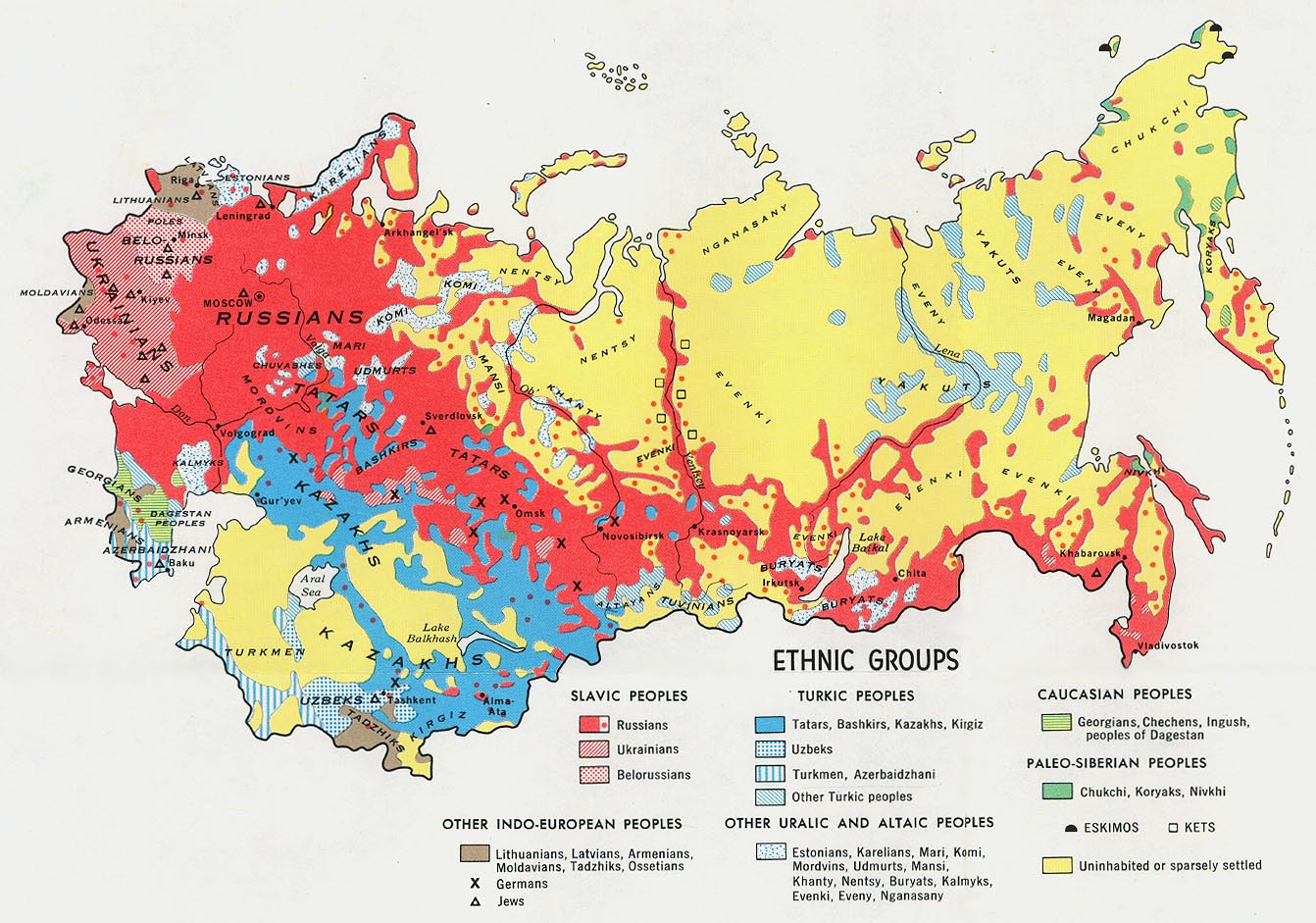
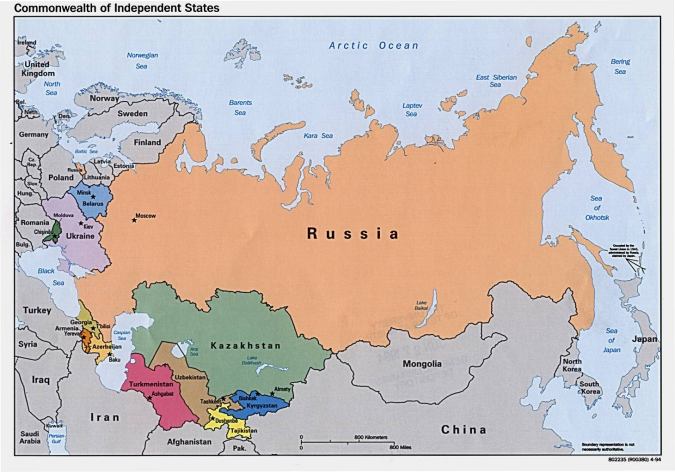
Although this is an ethnic map, the outline of the Russian heartland can clearly be seen in red and how other national groupings formed a barrier around this. For all of Russia's size, the yellow areas are virtually uninhabited. Not shown is Finland. Russia maintains a no-mans-land of between 3km – 10km between itself and Finland. The three Baltic states can be seen top left in brown coming around to Poland (not shown) and Belarus to protect itself from attack from Germany and the rest of Europe. Ukraine's southern border is the Black Sea. Its northern border is formed by the barrier of the Carpathian Mountains which also extend across Moldavia and into Romania. The Caucasus define the land bridge between the Black and Caspian Seas. The blue swathe is the great steppe of Kazakhstan. Before anyone could get into Kazakhstan, they would have to cross the high mountain plateaus of Uzbekistan; Tajikistan and Kyrgyzstan, collectively known as the Tien Shan. Together with Turkmenistan these formed part of the old Russian empire and it is definitely in Russia's interest to keep friendly relations with these. Finally to the east we get around to Mongolia with its great Gobi desert and then its border with China itself.

When communism fell in 1989 Russia lost control of all fourteen of these buffer states. The new Great Game revolves around Russia trying win back its influence in these states and the USA trying not to let it.

We are now going to have a look at the current situation in Central Asia and briefly at what is going on in Europe.

The Kyrgyzstan Revolution

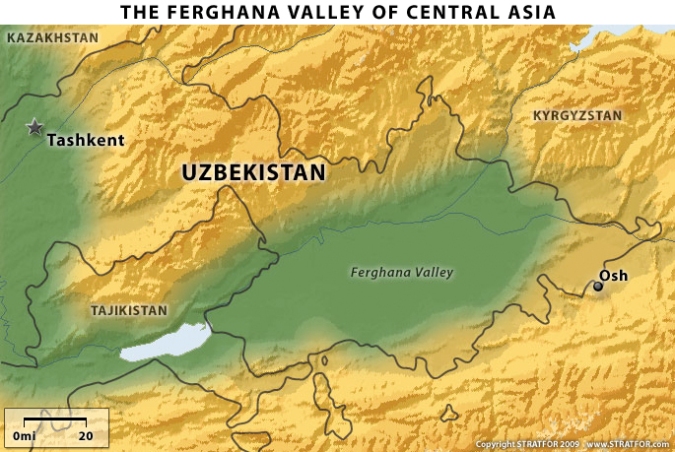
Kyrgyzstan (Dark blue, lower central) at first sight, does not appear to be much of a prize for anyone. It has no economy, no resources and it relies on its neighbours to feed its people. It does have one thing that is unique, its geographical position. To understand why, we must first discuss the Ferghana Valley. As we have already seen the Tien Shan Mountains divide Northern Asia from Southern Asia and prevent an attack on Russia via the Kazakhstan steppe. Russia lost this protection in 1989. Kyrgyzstan; Uzbekistan and Tajikistan all meet in the fertile valley of Ferghana which naturally is the home of the majority of peoples from this mountainous region. To stop any one country having overall control of this important region, the former CIS divided it up between the three states. Uzbekistan owns the valley floor. Tajikistan owns the entrance to the valley and Kyrgyzstan owns the surrounding mountains which protect it.

For years in Kyrgyzstan, there had been smouldering unrest against the then government of President Kurmanbek Bakiyev. Within 24 hours on a day in April 2010, discontent escalated into full blown revolution and a new government installed which immediately had the approval of Moscow. Of course Russia was using the techniques of the Arab Spring. There is nothing like
backing a winner when you pick the players and offer a tad of friendly assistance. The success of this has given Russia back one of its natural defence barriers earlier lost. Kyrgyzstan does not benefit economically from the Ferghana valley but it does benefit from encircling it. Control of Kyrgyzstan equals control of the valley and hence control of Asia's core. Kyrgyzstan (read Russia) now has the ability to monitor Chinese moves in the region. Its highlands overlook China's Tarim Basin which is part of the contentious Xinjiang Uighur Autonomous Region.
With the exception of the North European Plain, Russia’s expansion strategy focuses on the importance of mountains — the Carpathians, the Caucasus and Tien Shan — as geographic barriers. Holding the land up to these definable barriers is part of Russia’s greater strategy, without which Russia is vulnerable and weak. One part is now complete. Russia is on a time scale. It knows it must act quickly whilst the USA is preoccupied in Afghanistan and with the Muslim world. It will not always be like this and as much as possible must be gained before the USA's gaze returns to containing Russia and troops are redeployed.

Whilst Russia is in Disarray, the USA Will Play

The Soviet disintegration did not guarantee, of course, that Russia would not re-emerge in another form. The West, and the United States in particular, thus saw the end of the Cold War as an opportunity to ensure that Russia would never re-emerge as the great Eurasian hegemon. To do this, the United States began poaching among the states between Russia and its geographic barriers, taking them out of the Russian sphere in a process that ultimately would see Russian influence contained inside the borders of Russia proper. To this end, Washington sought to expand its influence in the countries surrounding Russia. This began with the expansion of the U.S. military club, NATO, into the Baltic states in 2004. This literally put the West on Russia’s doorstep at one of Russia’s weakest points on the North European Plain. At their nearest point, the Baltics are less than 100 miles from St. Petersburg.
Before the USA had its attention diverted towards the Middle East in 2003, it had already put plans into operation for the so called colour revolutions which bore fruition in Georgia 2003, Ukraine 2004 and Kyrgyzstan 2005, thus taking out Russia's main defensive barriers. Then one of those rare things happened, America blinked, or rather it averted its gaze towards the Muslim world. Realising that the USA was militarily stretched, Russia wasted no time in trying to restore the previous status quo. It has done this country by country using whatever techniques were appropriate for that particular situation. In January 2010, Moscow signed a customs union agreement to economically reintegrate Russia with Kazakhstan and Belarus. Also in January 2010, a pro-Russian government was elected in Ukraine. And now, a pro-Russian government has taken power in Kyrgyzstan.


As it seeks to roll back Western influence, Russia has tested a handful of tools in each of the former Soviet republics. These have included political pressure, social instability, economic weight, energy connections, security services and direct military intervention. Thus far, the pressure brought on by its energy connections, or disconnections, as seen in Ukraine and Lithuania, has proved most useful. Russia has used the cut-offs of supplies to hurt the countries and garner a reaction from Europe against these states. The use of direct military intervention, as seen in Georgia, has also proved successful, with Russia now holding a third of that country’s land. Political pressure in Belarus and Kazakhstan has pushed the countries into signing the aforementioned customs union. And now with Kyrgyzstan, Russia has proved willing to take a page from the U.S. play-book and spark a revolution along the lines of the pro-Western colour revolutions. Russian strategy has been tailor-made for each country, taking into account their differences to put them into Moscow’s pocket, or at least make them more pragmatic toward Russia.

Thus far, Russia has nearly returned to its mountain anchors on each side, though it has yet to sew up the North European Plain. And this leaves a much stronger Russia for the United States to contend with when Washington does return its gaze to Eurasia.

Next time the Caucasus. With four major players, three minor players and sixteen independent autonomous regions all with their own agenda, this is akin to playing three dimensional chess.

Sources
Looking for Trouble by Lauren Goodrich Reprinted from STRATFOR
The Joshua Project


Friday, May 10, 2013

UPDATES AND DISCUSSION


Part of the fire damage

From Murph

For those that are not aware of it, we had a devastating fire over a week ago at our place.   I would compare the mental state similar to not being home and someone coming in and stealing all of the stuff that is valuable to your life and never recovering it.   The fire destroyed the garage/shop, greenhouse and 4 other out buildings including an uninsured 20 ft travel trailer.  Every single one of my power tools burned up and a whole lot of other stuff also, a stash of tools collected over 50 years.   The house came close to burning down too.   All the animals didn’t have a problem.   It could have been much worse I suppose.  

I have been involved in a fire once before back in the 80’s when I then lost a whole bunch of custom made tools and equipment.   If you haven’t had a major fire in your life or a loved one hasn’t either, it is difficult to comprehend the physical and emotional loss.   For us, because of our chosen life style, it is huge.   Plus, we were underinsured to begin with.   We know that, at least eventually, we will make a decision about what we will do in the future.    For right now, we are devastated and somewhat out of equilibrium and we find it difficult to make decisions.    

Because of the insurance companies loses due to arson fires to collect insurance, it is not easy to get reimbursed by the companies.   Everything is now dragged out for what seems an excessive length of time while the company dithers about and does not make a decision.   They want to make damned sure that it wasn’t set deliberately to collect from them.   So cleanup keeps getting delayed.   Hopefully, it will be resolved this week.  

Nina, had a neat post up on the 19th of April about life’s tests:  http://deepintoartlifewest.blogspot.com/.  
I reckon we got ours big time.  Due to our age and what that entails, starting over seems to be a monumental and impossible problem.   Enough so that we have decided not to do a food garden this year.   Just too much on our plate to deal with it.   I do not currently have a place to put anything salvageable or purchased to get it out of the weather and I can’t do anything about it until the cleanup is done.   Neighbors, friends and organizations we belong to have offered help in the cleanup and maybe some of building if there is enough money from the insurance to do so.   Our paying forward in the community for the last 8 years does have some dividends. 

Here is a link of video after the fire

OK, enough on that subject.

It has been a while since I have done any opinion writing on this blog.   It seems that we are continually bombarded with information much of which can be legitimately questioned, principally, information from the government concerning economics and demographics.   I know that there will be strong disagreement with some of my more generalized statements on such subjects, but I still think there is strong arguments made for concepts like; world overpopulation, rapidly decreasing inexpensive resources, overt and extreme contamination of the environment, poisoning of the food sources, damaging extremism in every quarter, a general decrease in living standards in the western countries, lying to their populations by all governments, the financialization of everything, (I wonder when there will be a tax on breathing), climate change and the list goes on and on.  I make an attempt to keep up on the counter arguments for all of this.  Because I am not an insider on anything going on in the list, all I can do is take in the information that different folks present on these kinds of subjects.  Because I find the “expert information (opinions)” is often highly suspect I cannot depend on them for accuracy.  It appears to me that the best we can do is take in as much information as we have time for and then reach tentative conclusions, and I emphasize the term TENTATIVE.   I say this, because over time we may find that our conclusions were wrong by the evidence of events that actually take place, and that depends on how accurate the reporting is of those events because we aren’t there in person observing it.  

For instance, the major events in the last 10 years or so starting with 9-11 indicate to me that we are experiencing major big time government false flag manipulated events designed to keep the majority of the population fearful and insecure.   These show up in what appears as an escalation of absolutely crazy types of behavior that are very destructive on life and property.   Folks on the scene or folks that bother to do in depth research into such events are casting extreme doubt on the official explanations of what actually happened.   And, of course, their information can be highly suspect also.   Sandy Hook and Boston bombing are two such examples.   It has turned out that photographs and videos are no longer proof of much of anything anymore, too easy to doctor or outright falsify them or make incorrect assumptions on what they show by selective release of them.   

We also need to throw into these observations the personal bias that each of us has.   This controls to a large extent how we view contradictory information and what we choose to believe is true.   For me, it is the distrust of authorities and questioning anything they do or say.   My life experiences have not been particularly positive concerning authorities control (or attempts at control) over my life.  

Another concept that can be thrown into the mix is the vast increase in the complexity of our lives.   Voluntary compliance with all the complexity is nearly a full time job now days.   It didn’t used to be that way.    I’m a grumpy old fart and I have a strong tendency to resent and push back on all of this complexity.    I want my life to be fairly simple and the push to make it complex I find immensely irritating.   This is one reason that we don’t use social media, cell phones, and an overwhelming amount of other supposed “conveniences”.  To me, they have far over reached a point of diminishing returns wherein I would spend way more time dealing with these “conveniences” than getting done what I need and want to get done.    This applies to gathering information, principally from the web.   I do not want pop up news bites when I go on the web similar to the news bites on the popular TV news sites.    The selectivity and headlines are much more propaganda than real news for me to ponder.    So to simplify my information gathering, I have selected sites (biases) that I frequent that seem to me to be reliable and informative without the propaganda, and I realize that there is the possibility of inaccurate information, invalid opinions and status quo shills writing what I read or producing the videos that I take the time to view.   In other words, I take with some grains of salt what I come across or what is sent to me.    All to frequently, cross checking of information for validity is way too time consuming and/or impossible to validate.  

I consider the financial reports as falling into these kinds of categories.   The government consistently puts out data on all kinds of stuff that directly has internal contradictions and interpretations that appear contradictory to real life observations.   The employment figures are a prime example.   So is the reliance on stock market indicators as an indication of the health of the economy.    Frankly, I think that we have been lied to so much that none of it can be taken at face value.   None of this is new.   It was also going on during the last great depression.   Historically, it has been going on in every government since we have records of it.   In essence, those in power and have great wealth have bull shitted us for our whole lives and their mixture of facts and fiction leave us confused as to the actual situation.   On a personal basis, our hassles with the insurance company over this fire is another example.   We have conflicting goals.   The company wants to pay out as little as possible and we want max payout to us.   The consequence is that they are stonewalling us and hope we will get desperate and take a cash-out as settlement.   Sigh.  

I’m sure most of our readers have similar stories. 


Thursday, April 11, 2013

Poetry


Rockpickers Cattle Dog, Colleen


It is darkest at the new moon. Now there is just a sliver of light. We are assaulted on all sides by possible disasters - collapse, tyranny, famine, disease, earth changes, war. Or, are we carriers of an apocalypse meme transmitted like a virus through generations? Sometimes it is hard to tell. We need to take stock of ourselves. We need to come to terms with our experience. We draw our attention away from the seductive outside matrix and turn within to the intense present, attempting to make some sense of it, assimilate it, perhaps heal it.
To our good fortune, we have at this campfire one who wields words as deftly as he does stone. A master craftsman, he builds each poem word by word like a wall with each stone fitting perfectly to another. Rockpicker generously shares his cultivated perceptions with us along the path we walk. I have asked him to collect his most recent poems, that they may be read as a collection. 

I figure that there are plenty of subjects covered here to renew the conversation once again.

freeacre


The following is all Rockpicker ....

After An Ice Storm On The Allegheny Plateau

Beyond the sumac tangle, where a thinning father saws,
a grandmother shagbark hickory sags with loss.
Split limbs scrape like clay shards tied in wind.  Wind
the sawyer knows and ice conspire some bad years
to open crowns and let a good son in.  He revs
his Stihl.  Green pulp sprays from kerfs and sticks
to boots, consecrating snow like scattered ash.

You stand a distance off and dream the taut trunk limber.
Remember a girl, smart, green as whip?  You loved her.
This ancient snag, lithe in youth, was left by men
long dead for shade.  You like to think she chose her ground,
bolted free of gloom so deep a bright moon hurt, and ran,
breaching walls to reach this mid-field stance.  You're
confused.  The figure you remember kept running.

Some bad years snap the stoutest dreams like twigs.
Cures fail.  Stunned villagers inter a shining son.
A wife says 'leave.'  Once each life thin fathers
flesh-out plans to restack stones, slash brush
and honor the old delineations.  Buck up the knotted way
life doesn't go.  Toss rounds to boys who still trust dreams
and cart your grief like cordwood home in snow.


Stopping For Pelicans On A Summer Evening


Driving the Road to the Buffalo home,
Oldensoul, over my shoulder, spots
a  helix of featherworks bursting
the cloudless blue near where
roads and waters merge.  We pull off.
Low over yellow grass, black wings
work the yellow grass for what
it's worth, unaware, or perhaps,
unimpressed, by the grace overhead.

Flashes of winged bodies appear
out of nowhere unencumbered in air.
They flare white, a hundred points
of light, a flock of blossoms,
each banked turn when sun hits right.
Up and up they climb, uninstructed,
free, repeating explosions of ecstasy.
It takes our breath.  They bloom,
fade and bloom again, delirious

anarchy on zazen wind.
This whirling is a public mirth, a stirring
of rapture, loosed of earth.  And isn't
this coming together of a green day
with affirming moon and the scent
of new-mown hay a way to sing
our love song back to a black-winged world?


Waiting For The Signal

These pages that bring us together
are the fire in the cave above the stream,
no dream we move in and out of, faceless,
expendable, waiting for a burst of wings
to spill our pooled bones like coins
over the chilled and silent ground
we fell in love with so long ago,
singing the green hills home
under that shovel-shouldered sun.

Fatigue works grim the stone of souls.
No talk is needed to believe the bleeding
will be ours all too soon. Needled dust,
that settled itself in honest lungs, cut
with each rasp, yet the bleeding
wasn't stemmed. Quick, black tongues
flicked from windows, floors below dustified
slabs, while the Street slumped with peanuts
and a beer, cheering each new diversion.

In our rush of voices a stream curses
the murmur of pines. In our names,
what we begged for never to be done,
is done with no shame. And the day
drags its blindered self to toil. Night trades
whiskey pete for oil, while down slope,
death-drummer birds with blazing eyes
ascend the holy crags to raze dissent
before we waking innocent arise.


NDAA, 2012


I'm waiting empty in a cold house,
with shamrocks, the dog and favored books,
listening for the old tread of new boots
gunning to kick- in this loose-hinged heart.

The grasping hands of those with much
to lose, I imagine, close on me.
They drag me, incendiary,
into their unmooned night.

Half a shot of Tullamore on the table
is how my neighbors find me gone.
No bloated stench. No skeletal sneer.
Only a storm door banging mad in wind.


A Question For The Commander-in-Chief

When a bunker buster
falls in the desert
and no one
shows you photos
of the shadows
of little bodies
etched
on concrete walls,
are the screams
of insane mothers
drowned out
by the drone
of empire?

-for FP


White Lies Over The Passamari


Since oxygen and hydrogen combine
when kerosene is incompletely burned
at thirty thousand feet in crystal air
to form a gaseous water we can't see,
but know it's there because it changes
state, cooling in the rarefied minus seventy degree
Montana sky to first, (briefly,) liquid, and then to ice,

fine particles, yes, but solid enough
to refract a wan sun. " Contrail,"
we say, looking up over garden walls,
over the ridgelines of  neighboring houses.
We follow the silver bird, and its vapor,
across the sky, the two small enough
to hide behind raised fists

because ice reflecting sunlight
takes on heat and changes back
to states we only dream.   So what gives
with these spreading trails in tick-tack- toe?
Is it rocket science I'm not allowed to know?
White skies replace our deep blue days.
Shouldn't we expect a little say?


Sky Collapses On The Passamari

Winter sky drapes the land, like a canopy
dropped by unseen hands upon a cage.
Farm ground blurs between houses
at an imprecise place, over the creek, 
beyond my neighbors' spruce.  Past
what we can see spreads
the topography of an uncertain age.
Fence posts pitch and lose themselves
in fog, like stick men heading off
to evening chores, or the dutiful poor
marched off to kill the poor in forgettable wars.
What I took for granted and thought I knew
when sunbeams slanted through
transparent pain, seems now
untenable and untrue.  Still, rockslides
and dying forests loom, like deficits
we must assume in this obscuring air.
The looted vault gapes,  a victim's mouth.
Herefords steaming under willows
birth their calves.  The little town rubs
its knees beside a flame and tunes
its set for a prompted reassurance.
I kick the empty streets in muffled gloom.
I bounce solid hopeful notes off walls
of unsold homes.  Kept birds balance
in dim rooms, each night, a new deception.
With sky this low, could it be more clear?
What we need to know we musn't hate or fear.
On the Passamari, the dog star fluxes, red
to green, whether occluded or seen.


Fukushima, Passamari, Spring

Bow-legged two-legged, leaning on his hoe
peers for garlic,  late,  beneath the plum.
Shirt cuffs splay like stalling wings in wind.
He veers a stretch of sky between limbs
and bed, tallying spears as if a golden
gauging hares.  Planes his friends insist
don't spray poison for many good reasons
and returning geese persist against
the pelt of fronts.  A neighbor's tom
deserves his adulation.  Clouds decay
to cumulus and haze when no fields burn.
A fat mouse dies without a kick in yellow grass.
Orach cotyledons pool in paths like blood.

Early spinach vernal under hog fence hoops
and plastic from the dump needs safe water
from the county's deepest well.  Still, rain
threatens,  at a hundred counts per minute,
not him so much but kids who play next door.
When did the world's backup generators seize?
The missing witness, shoeless on the tape,
muttering, stumbled- on by mistake
in a landfill heap.  And this newest war,
when were there debates?  He leans on stone
to sort intrusive roots from wanted stock.
One wind whips the town's flags all directions.

Doves weight air a gray he shoulders
like a bar.   Admitting defeat so late and far
from sanctuary waves, snow geese argue
security measures all the way to straw.  Truth
is north and hurts worse faced head on.
Land a million peasants hoed subsides
while dying aspens turn silver he can't save
and nations crash in gardens like the sea.
Aerosol merges white in ionized sky
when sun unwinds in tongues that peel his ears.
Teetering worlds lose bearings like bickering geese.
He takes the dog whose eyes yearn for a walk.
She shows him when you turn you're halfway home.


Cowdog Passing

I came down in the morning
to find her, eyes open, stiff,
and let her lay in her blankets
against the sofa until mid-day.
When late- winter sun transcribed
the bare limbs
of the old Chinese elm
into inscrutable lines
on softening ground,
I laid her facing east
into her new day, covered her
with earth in the raspberries
and drove away.
The short trip to the dump
never seemed so long,
the muddy truck seat so empty,
as it did that day.


Magnetic Ribbons and the Yellowcake of Faith


When we wake puking shame
at last, and know the dream
for sham, embraced en masse...
When bells that rang victorious
hang mute, their tarnished claims
ignored in disrepute, and
bitter sons, having been all they
could be, can't wish back innocence
or the leg below the knee...

(This brash regime's  trimmed reason
from its ranks, its black guard
in the street, protecting flanks.)

...then will we heed the schemers'
gloating leer? "There's no future,
for dissidents,  here."
Row on row, with hand
in trembling hand, it's come to this:
We dreamers need to stand.


Thursday, March 7, 2013

THE CANNIBAL CABAL

Google Images


from  freeacre

Is there no depth of depravity too low for the scumbags in government, finance, and media? Apparently not. On every front, we are continually assaulted by new atrocities. We read articles reporting that cancer and AIDS and hepatitis, killer flu, Alzheimer’s, autism, and god-knows-what-else is spread by mandated vaccines – and yet it continues unabated. Our food supply is contaminated by known carcinogens and gender-bending pharmaceuticals, and the regulators that are supposed to guard the safety of our foods are the same corporate wankers who develop and market them. Our country has become an empire relying on unending and undeclared resource wars to secure diminishing supplies of oil, water, natural gas, farmland, and whatever else the corporatists feel entitled to. Our money is created from a decision by the Federal Reserve to create electric zeros in a computer, then lend them to the government with interest, putting us in indentured servitude for generations, while the fat cats get mind-bendingly rich. Then this financial debt abomination is used to prop up the stock market because, for them, debt is money.  Rights defined “inalienable” as citizens of this land have been first compromised and now repudiated. No more right to a fair trial. No more right to assemble or free speech. “Whistle-blowers” are incarcerated and tortured (read the Rolling Stone article this month about Bradley Manning) or renditioned or killed. Our attorney general just admitted that the president has a hit list and pretty much anyone can be on it. Objecting to this outrageous turn of events can lead to being considered a “terrorist.”  Hugo Chavez just died from cancer (or a heart attack) and the world wonders if we didn’t just kill him. Why not? We admitted to trying to kill Castro. Hell, even our own President Kennedy was assassinated and the culprits never identified. To say nothing of 9/11.  So, no. There are no depths of depravity too low to go.

Why not?

On my recent trip to Portland I picked up a wonderful little book, “Make Gentle the Life of this World,” by Maxwell T. Kennedy. I had lost it years ago and was delighted to find it again. It is a homage to his father, Robert Kennedy, and filled with quotes from his father and quotes from his father’s personal collection. What strikes me in reading it again, is that it is a book that could not have been written today. It’s too gentle. Too compassionate. Too beautiful. I doubt that it could get published now. Not in this competitive celebrity driven culture in which we find ourselves suffocating.  Watch Chris Hedges recent speech on our carnal celebrity culture:

What is happening to humanity? It appears that the world is being taken over by psychopaths. Here is the definition from Wikepedia:


“Psychopathy (/saɪˈkÉ’pəθi/[1][2] is a personality disorder that has been variously characterized by shallow emotions (including reduced fear, a lack of empathy, and stress tolerance), coldheartedness, egocentricity, superficial charm, manipulativeness, irresponsibility, impulsivity, criminality, antisocial behavior, a lack of remorse, and a parasitic lifestyle. However, there is no consensus about the symptom criteria and there are ongoing debates regarding issues such as essential features, causes, and the possibility of treatment.[3]
While no psychiatric or psychological organization has sanctioned a diagnosis of "psychopathy" itself, assessments of psychopathy are widely used in criminal justice settings in some nations and may have important consequences for individuals. The term is also used by the general public, in popular press, and in fictional portrayals. This popular usage does not necessarily conform to the clinical concept. According to the Scientific American, although psychopathy is associated with and in some cases is defined by conduct problems, criminality or violence, many psychopaths are not violent, and psychopaths are, despite the similar names, rarely psychotic.”

So, what is the cause of this condition?

Paul  Levy on Reality Sandwich (http://www.realitysandwich.com/greatest_epidemic) writes of “wetikos,” a native American word for those suffering a sort of psychic virus manifesting in people who can’t get enough.
"this disease, this wetiko (cannibal) psychosis, is the greatest epidemic sickness known to man."[vii] We, as a species, are in the midst of a massive psychic epidemic, a virulent collective psychosis that has been brewing in the cauldron of humanity's psyche from the beginning of time. Like a fractal, wetiko operates on multiple dimensions simultaneously -- intra-personally (within individuals), inter-personally (between ourselves), as well as collectively (as a species). "Cannibalism," in Forbes's words, "is the consuming of another's life for one's own private purpose or profit."[viii] Those afflicted with wetiko, like a cannibal, consume the life-force of others -- human and nonhuman -- for private purpose or profit, and do so without giving back something from their own lives. One example that symbolizes our self-destructive, collective madness is the oil companies' destruction of the Amazonian rainforest, the lungs of our planet. This is literally a full-bodied revelation showing us what we are doing to ourselves. Another literal example that is symbolically illustrating the wetiko complex in action is Monsanto genetically engineering terminator seeds that do not reproduce a second generation, thus forcing farmers to buy new seeds from Monsanto for each year's new crop. This makes survival for many poor farmers impossible, which has triggered a wave of suicides among farmers, as Monsanto grows richer from the process.

Forbes writes, "The overriding characteristic of the wetiko is that he consumes other human beings, that is, he is a predator and a cannibal. This is the central essence of the disease."[ix] Predators, "full-blown" wetikos are not in touch with their own humanity, and therefore can't see the humanity in others. Instead, they relate to others either as potential prey or as a threat to their dominance. As if a different breed who is more animal-like predator than ordinary human being, someone fully taken over by the wetiko psychosis consumes others' lives, physically, emotionally, psychically and meta-physically, beyond just the material body and physical possessions to the level of meaning itself. Wetikos are the "anti-artists" of our culture, embodying the opposite of what creative artists do. Unlike an artist (please see my article "The Artist as Healer of the World"), who creates life-enhancing meaning and enriches the world without robbing others, a wetiko takes and consumes without giving anything back, continually draining and impoverishing the planet of resources.

We are currently in the midst of "the greatest epidemic sickness known to man" (please see my article "Diagnosis: Psychic Epidemic"). Many of us don't even realize this, as our collective insanity is so pervasive that it has become normalized. Our collective madness has become transparent to us, as we see and interpret the world through it, rendering our madness invisible, thereby unwittingly colluding with the collective psychosis that is wreaking incredible death and destruction on our planet. Being "trans-parent," our madness is beyond its mere appearance, which is to say, "beyond being apparent," i.e., not visible. Our collective psychosis is invisible to us, as it expresses itself both in the very way we are looking, as well as all of the unspoken ways we have been conditioned not to perceive. Due to its cloak of invisibility, we don't see our madness, a psychic blindness which makes us complicit in the creation of our madness.

Many of us can't fathom the level of evil to which full-blown wetikos have fallen prey, and of which they are capable. Our lack of imagination of the evil existing in potential in humanity is a direct reflection of a lack of intimacy with our own potential evil, which enables the malevolence of wetiko to have nearly free rein in our world (please see my article "Shedding Light on Evil"). In our psychic blindness we are complicit in the spreading of the evil of the wetiko psychosis, a systematic evil whose depth is beyond the capacity of words to fully describe.”

Ok  I’m back now.   Whew!

Does it spring from the “reptilian” part of our brains left over from natural evolution processes or some actual alien reptile influence?  http://www.examiner.com/article/conspiracy-theory-returns-november-7-to-trutv?cid=db_articles

At any rate, changing the minds or appealing to the non-existent hearts of these malefactors, is not going to be easy. Maybe it is impossible. Perhaps we are into cycles described by the ancient Hindus or Mayans who see long cycles of birth, progress, deterioration, death and re-birth as being just how the universe is wired.
When I was young I thought that hearts and minds could be changed by exposing them to facts and appealing to their consciences. Like, to end the war in Vietnam or to get rid of racism and injustice or to promote health or the well-being of the collective humanity of which we are all a part. Well, you can see how well this has worked out. …

Scum has risen to the top. Most of the ones in charge really don’t give a fuck about us, as George Carlin used to rant (bless his heart). Of course there are noteworthy exceptions that attempt to swim against the tide of greed, power, privilege, convenience, and selfishness. But, it seems to be a losing battle so far. From our last post comments, I know that our own dear p, feels that we are all one – even the wetikos. Once we embrace that shadow that is in all of us and deal with it instead of denying it, there is hope for empowering the sacred within us all as well. One hopes.

Meanwhile, we are like the little marsupials that scampered around the Jurassic period trying to survive without getting stepped on or eaten by the dinosaurs. Happily, the asteroid came along that wiped out the reptilian monsters and set the rest free. Maybe history will repeat itself.


Sunday, January 27, 2013

ONCE MORE ON SUSTAINABLE POWER SOURCES

Folks, instead of posting a picture I am posting a link to read that is about this post subject material. 
http://www.aweo.org/problemwithwind.html
While I see some problems with some of the content of this site, I do think that overall it outlines some problems over this renewable energy that most aren't aware of.

From Murph


I’m sure most of the readers on this site are quite familiar with all the hype concerning sustainable/green power being pushed by various sources all over the news and internet.   I have written about them periodically over the years and I’m going to hit on it again today.

First, some things that I think we can agree on concerning the basics of this.   Everyone of the schemes for nearly free power also demand the use of non renewable resources, everyone one of them, from nuclear to wind to solar power to the touted free power from the ether or the magnetic characteristics of our universe.   To build the machines to harness those power sources takes non-renewable resources, at least in human lifetime measurements.  

Secondly, we need a working definition of “sustainable”.   In the absolute sense, which, seemingly, no one wants to talk about, it means that resources are not used up faster than they can be regenerated.   I can understand the reluctance to look at it that way because everything that is renewable in human life time terms is based on sunlight, including, lumber, farming, water critters we eat, drinkable water and breathable air.    That does not include the vast amount of substances we mine out of the ground.  They are renewable but on a scale of time that makes them meaningless in terms of human societies.   So, excluding what might as well be termed as non renewable resources what is talked about in sustainability is how long those non renewable resources can last and under what conditions and scale of usage.  

If we try to produce all the electricity needed by the use of the “green” technologies, we also have to look at how much of the non-green technologies and resources also have to be used.   It appears to me that the amount of non-renewable resources to do this would be incredible and that does not include the cost of infrastructure to utilize it and the cost of maintenance and repairs.   The current big buzz is of course solar and wind power.  

I am going to assert that from an economic and resource position, neither of these sources are viable.   

Take wind power.   I presume all of you have looked at these huge wind turbines that are mainly being built in China.  They are gigantic and take a huge amount of infrastructure and non-renewable resources to build, install and maintain.   Plus, I have mentioned before, there is a very simple problem with physics here.  It is called the law of conservation of energy and the laws of thermodynamics.   Simply put, if you remove energy from one place and convert it to another form of energy, you have inherent losses but the amount of energy stays the same, just at a lower lever.   We all know that the movement of air (wind and currents) controls what the weather is at any particular location and time.   The energy to move air around is controlled by many other factors but one of the largest factors is the sun, heating and cooling areas of the earth and causing wind.   So, putting up a windmill pulls energy out of the air movement and converts it to electricity.   The result is less energy in air movement to some amount.   If enough of these huge wind turbines are built and installed, the question comes up as to whether they will have an ultimate effect on the movement of air, ie, the weather.   Now I realize we are talking about a huge artificial system compared to the even larger ecological system we call weather.   But, I have seen no studies concerning what can/probably happen if we build enough of those huge turbines.   I rather suspect and assert that there will be a large influence on weather patters if enough of them are put up.  What amount of changes and the observable effects is not being investigated as far as I know and what the tipping point would be.  Is this just another example of ignoring the consequences of our actions? 

Virtually the same observations also apply to solar power.  If enough of the sunlight hitting the earth is converted to electrical power, what happens to the weather patterns influenced by the heat of the sun?   Again, I find no research on this subject.

The standard retort concerning this is that the ecological system is so huge and the amount of energy it contains is so big and the amount of energy we could possibly drain from the system is too small to make a difference.     This point of view is touted by folks with little or no training in the sciences, mostly by the political class but not limited to them.   

IMO, it is a mute point.   I do not think that we have the resources or the ability to make sufficient investments to get to the point of unforeseen consequences.   But, government and private business is going to try.   The amount of damage they can inject into the ecological system and society by trying is going to be severe I think.   

On to the “free sources of energy”.   There is lots of information on the web concerning these schemes.   I have no idea concerning their validity.  However, for the same reasons above, there ain’t no such thing as “free energy”.  To use the purported electromagnetic properties of our universe takes non renewable resources in the form of rare earths and oil and mined metals.   I am going to assert that there isn’t enough of these resources left at a price that is affordable to make either home units for everyone or scaled up devises to feed the electrical infrastructure we have or could develop.  

Now, in contradiction to all of this, I will admit that I would produce my own electrical power for my own usage if the cost benefit ratio made it worthwhile.   I also admit that I would ignore that ratio if the cost came down enough where I could handle the out of pocket cost.   What it comes down to is being able to continue to use electrical power in the advent of the grid having prolonged outages or just plain going away.   Home generators can handle short-term power outages.   It’s the longer term ones that I would invest the money in for our use.    But, currently, to run our household on personal generation of electrical power is not feasible.   I suspect this is also true for most homeowners in this country.   What I can do is put in, relatively speaking, enough generating capabilities to run essential elements of modern life, namely, preservation of refrigeration and water source and maybe even cooking.   Heating would still be a problem since we have a central electrical furnace.  (The codes involved to put in a wood heater present an even larger outlay of money)   A friend who lives nearby has put in a small system to run the essentials with some success.   To put in something similar would cost me in the neighborhood of $1500-$2000.  This might be doable, will take some more investigation.  

I am all for individual homeowners being able to continue operations at home in the event of a cut-off of power from the grid.   I am also in favor of finding a way to produce power that is not so destructive of the environment and is affordable.   However I think that the present directions of this push are a blind alley.  In the end, I think we are all going to have to learn how to live without access to continuous multiple power sources that are needed to keep us comfy and uninvolved in the events taking place around us.  

Sunday, January 6, 2013


Picture from "Django Unchained"
 2013 Now What?


Here it is – the first week of 2013. I find myself crawling out from my emotional bunker as I realize that I have survived the much-anticipated assorted disasters of 2012.

Now what?

 We still seem to be facing the same challenges to our well-being: the globally orchestrated financial debacle, the corruption of the government, the burgeoning police state, the deterioration of the environment, never-ending resource wars, the failure of our healthcare system, disarming the citizenry, and on and on. I read a report recently that said if we add up all the governmental debt and include all the social security and Medicare obligations that have already been squandered, each man, woman, and child would owe over $180,000 – with interest. That puts us and our progeny in the “indentured servant” category. Slaves, essentially, since it is an amount that can never be re-paid.

We are living in a concentration camp without walls because they don’t need walls anymore. Our owners have drones, militarized police, unlimited surveillance, and have abolished our right to a free trial everywhere in the country. You can’t even characterize it as a reservation, since, even nominally, there is no place we can call our own. Much like a plantation in some areas, with the one percent living in the Great House, and the rest of us wage slave/consumers doing our obligatory debt shopping, while the old and disabled are fleeced by the medical and pharmaceutical industries. What the hell happened?

Charles Eisenstein has a good take on this progression in his essay on Reality Sandwich entitled “The Space Between Stories.” He writes,

“Sometimes I feel intense nostalgia for the cultural mythology of my youth, a world in which there was nothing wrong with soda pop, in which the Super Bowl was important, in which the world's greatest democracy was bringing democracy to the world, in which science was going to make life better and better. Life made sense. If you worked hard you could get good grades, get into a good college, go to grad school or follow some other professional path, and you would be happy. With a few unfortunate exceptions, you would be successful if you obeyed the rules of our society: if you followed the latest medical advice, kept informed by reading the New York Times, and stayed away from Bad Things like drugs. Sure there were problems, but the scientists and experts were working hard to fix them. Soon a new medical advance, a new law, a new educational technique, would propel the onward improvement of life. My childhood perceptions were part of this Story of the People, in which humanity was destined to create a perfect world through science, reason, and technology, to conquer nature, transcend our animal origins, and engineer a rational society.
From my vantage point, the basic premises of this story seemed unquestionable. After all, it seemed to be working in my world. Looking back, I realize that this was a bubble world built atop massive human suffering and environmental degradation, but at the time one could live within that bubble without need of much self-deception. The story that surrounded us was robust. It easily kept anomalous data points on the margins….”

Eisenstein says that we are between cultural stories. We are living through the dissolution of the story that we were telling ourselves about our reality and creating a new one. Hopefully, it will be a more sustainable one.
  
Unfortunately, our public educations do not include much history about the coping mechanisms people who were slaves used to survive. We have the enduring legacy of music –  the Blues, the dances, the slang terms used so the “massas” couldn’t understand what they were talking about. We have the eloquent prose of Frederick Douglas and Sojourner Truth. We also have the wisdom of the American Indian leaders of the day. It wasn’t all about picking cotton.

Today, as our collective consciousness is coming to terms with our vanishing liberty, a new movement out of (all places) Canada has emerged. Calling itself “Idle No More,” it is beginning to catch the imaginations of people all over the world. Here is an excerpt from an essay entitled “The Wild Fire of Idle No More” by Morgan Maher on Reality Sandwich.com, 

“…Naomi Klein commented: “The #idlenomore round dances taking over shopping malls during xmas rush r the most subversive actions I've ever seen “
Klein's excellent article for the Globe and Mail succinctly maps the vast, complex details that fuel Idle No More
" … the time for bitching and moaning is over. Now is the time to act, to stand strong and unbending for the people, places and principles that we love.

… the Idle No More movement – its name at once a firm commitment to the future, while at the same time a gentle self-criticism of the past. We did sit idly by, but no more.
During this season of light and magic, something truly magical is spreading. There are round dances by the dollar stores. There are drums drowning out muzak in shopping malls. There are eagle feathers upstaging the fake Santas. The people whose land our founders stole and whose culture they tried to stamp out are rising up, hungry for justice. Canada’s roots are showing. And these roots will make us all stand stronger."

Idle No More is spreading like hurricane wildfire throughout the world. Canada, USA, Europe, Australia, Egypt, Palestine, Colombia... the list goes on.

I am wondering the escalation of the neo-con efforts to dominate and control the global masses, is leading to our recognition of our combined slavery whether we are on the “left” or the “right.” We are beginning to react in a way that encourages a more indigenous and human reaction to the despicable reptilian corporate abuses.

Whether one is by nature a warrior, a teacher, a healer, a techie, or simply a concerned parent or comedian,  seems to be a place for each of us in the generalized resistance.

Check out some of these links and let me know what you think.


http://www.realitysandwich.com/2013_space_between_stories
http://www.realitysandwich.com/wild_fire_idle_no_more
http://www.ishtarsgate.com/forum/showthread.php?3810-2013-The-Rebirth-of-Venus-and-the-Return-of-the-Divine-Feminine&p=20529#post20529
http://www.shtfplan.com/headline-news/insider-report-dhs-was-created-to-to-fight-americans-not-protect-them_12282012